
What is a Confined Space?
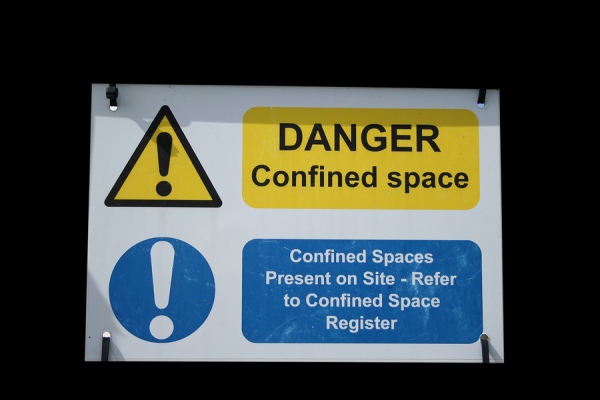
A confined space does not necessarily mean a small, enclosed space. It could be rather large, such as a ship's hold, a fuel tank or a pit.
One of the first defining features of a confined space is it's large enough to allow an employee to enter and perform work. The second defining feature is it has limited means of entry or exit. Entry may be obtained through small or large openings and usually there is only one way in and out. The third defining feature is that confined spaces are not used for continuous or routine work.
Permit or not
All confined spaces are categorized into two main groups: non-permit and permit-required. Permit-required confined spaces must have signs posted outside stating that entry requires a permit. In general, these spaces contain serious health and safety threats including:
- Oxygen-deficient atmospheres
- Flammable atmospheres
- Toxic atmospheres
- Mechanical or physical hazards
- Loose materials that can engulf or smother
Although the danger in a confined space is obvious, the type of danger often is not. For example, a confined space with sufficient oxygen might become an oxygen-deficient space once a worker begins welding or performing other tasks.
These are some of the reasons confined spaces are hazardous:
- Lack of adequate ventilation can cause the atmosphere to become life threatening because of harmful gases.
- The oxygen content of the air can drop below the level required for human life.
- Sometimes a confined space is deliberately filled with nitrogen as a fire prevention technique. Nitrogen cannot sustain human life, so you must use respiratory protection.
- Many gases are explosive and can be set off by a spark.
- Even dust is an explosion hazard in a confined space. Finely-ground materials such as grain, fibers and plastics can explode upon ignition.
- Confined spaces often have physical hazards, such as moving equipment and machinery.
- Tanks and other enclosed confined spaces can be filled with materials unless the flow process for filling it is controlled.
Before entering any confined space you must test the atmosphere to determine if any harmful gases are present. There must also be radio contact with an attendant outside the confined space and a rescue team at the ready in case of an emergency.
What confined spaces do we have around our workplace? Which are permitted? Can any of them be reclassified?
